

Phonemic Awareness is a huge buzz word right now. I’m sure you’ve heard it, right? It seems like every reading program boasts phonemic awareness as a component lately. But, what does it mean anyways? For the longest time I felt like David from Schitt’s Creek when he was trying to “fold in the cheese.” It’s easy enough for people to tell me to do it but when looking for guidance in how to implement it I got more of the same. “Just do phonemic awareness! it’s important!” (Just fold in the cheese!)

Don’t pull a David…I’m here to help! Phonemic awareness is the first step towards reading. Kilpatrick defines phonemic awareness as, “the ability to recognize and manipulate individual phonemes (sounds) in spoken words.” (David Kilpatrick, Equipped for Reading Success) Let’s start back at the beginning. Babies start off communicating by crying. Eventually they learn that words can more efficiently communicate their needs. This progression is natural for us as humans. It’s as soon as we start to communicate through written words – through writing and reading – that things get complicated. Reading is not a natural act for humans. It’s actually very difficult for our brains to learn to read. We have to make completely new connections in our brains to do it! So we start simple, with something our littles can do quite well…talk!
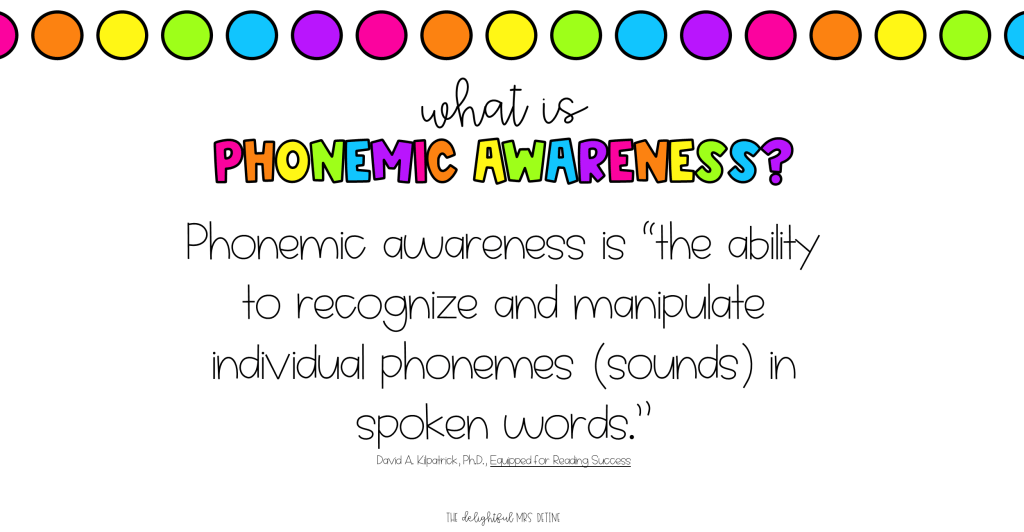
Phonemic awareness is an oral exercise. It can be done in the dark. There is no need to attach graphemes (letters) to the phonemes (sounds) quite yet. Letter and sound knowledge is equally important on the path to reading, but does not have to be solid for a child to work on phonemic awareness. In fact, you shouldn’t apply letter names to the sounds at first! The goal of phonemic awareness is to make children aware that words are made up of sounds and to get them familiar with all the sounds in our words. Their ability to manipulate sounds in spoken words will help them to map those phonemes to graphemes and store words into long term memory.
Phonemic awareness can be done in the dark.
In Kilpatrick’s book he notes that there are many tasks that have been identified by researchers including rhyming, alliteration, categorization, blending, segmentation, isolation, and manipulation. However, he goes on to note that manipulation of the phonemes is the most efficient method for training phonemic awareness since it incorporates segmenting, isolating, and blending. Work smarter, not harder, right?!
You can manipulate phonemes in many ways. When working with Kindergarten groups, or students who really struggle, I stick to syllables. I start off with compound words, then work our way towards two syllable words, then eventually 3 syllable words. We put together syllables, omit the first syllable, and then omit the final syllable.
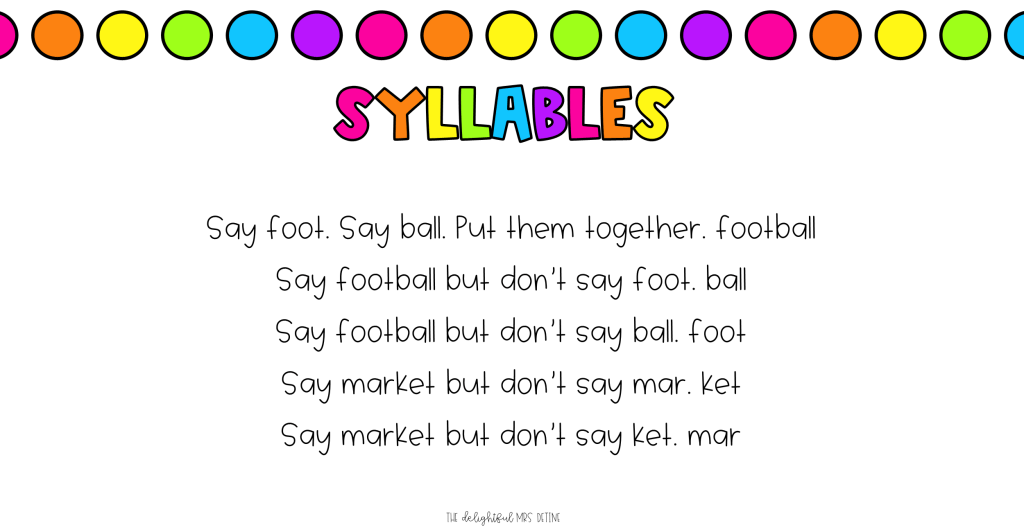
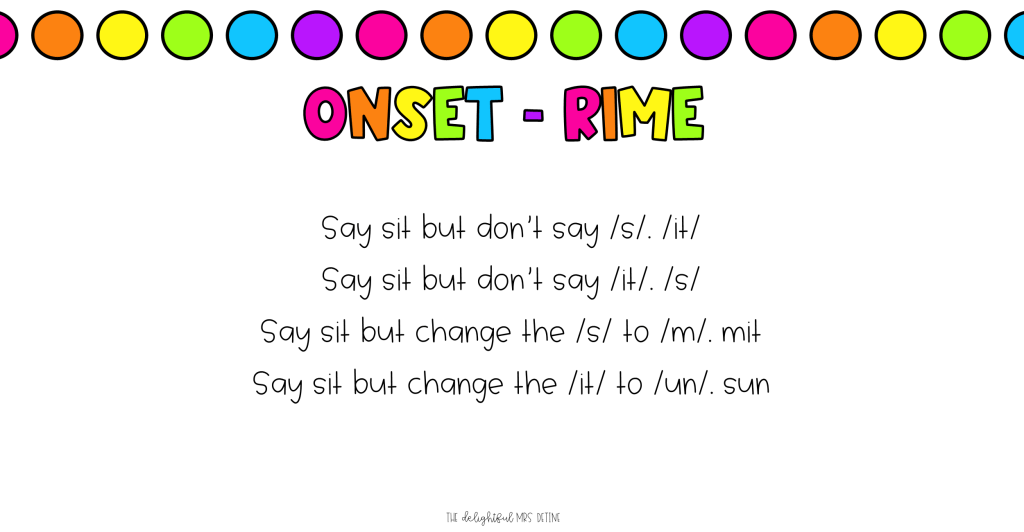
When student’s become proficient (can easily manipulate syllable with no errors) with syllables I move on to onset and rime. We omit the onset, omit the rime, change the onset, and change the rime.
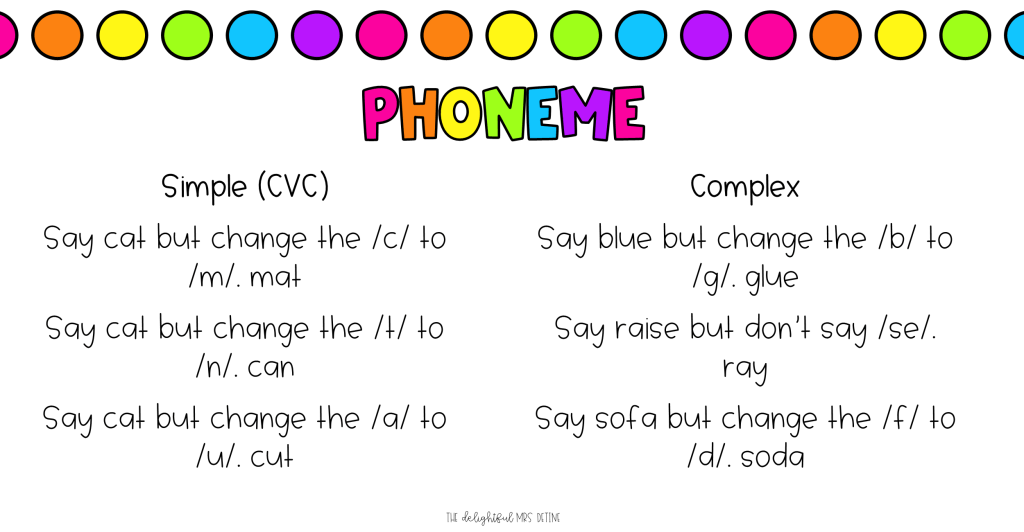
Once a child is proficient in onset-rime, I move on to phoneme manipulation. I start with CVC words and omit and manipulate the phonemes in the words. Eventually we move on to more complex words with blends, vowel patterns, prefixes, and suffixes. This is where things get really tricky! This level of manipulation often doesn’t occur until well into second grade.
What does it look like in a classroom? I do one minute drills with my students as a warm up during our structured literacy groups. When I was teaching Kindergarten we would do drills whenever we had a free moment!

In my intervention groups this year I have been using the PAST (Phonological Awareness Screening Test) to assess my student’s ability. I have also been using Kilpatrick’s one-minute drills to work on phonemic awareness skills with my students. It has been incredible to see how as their phonemic awareness grows, their decoding abilities increase and become more fluent! I highly recommend purchasing Kilpatrick’s Equipped for Reading Success to learn more about phonemic awareness. It is a program for phonemic awareness and includes a TON of one minute drills. It’s worth every penny!
You can also find free lists of words at The Six Shifts website. The book Shifting the Balance, by Jan Burkins and Kari Yates, also includes great information on phonemic awareness and is a great place to start.
You can also pull words from around you in the moment! If I’m walking with a student I’ll often look around and find a word that will work. If there’s a star on their shirt we use that word. If we see a staff member we use their name or their job in the school. If there’s something exciting coming up (ex. a big football game, a holiday, or a special occasion) I’ll use a word related to that. It all feels complicated at first, but once you start you’ll be able to think of words quickly! Often the kids will come up with words for me!
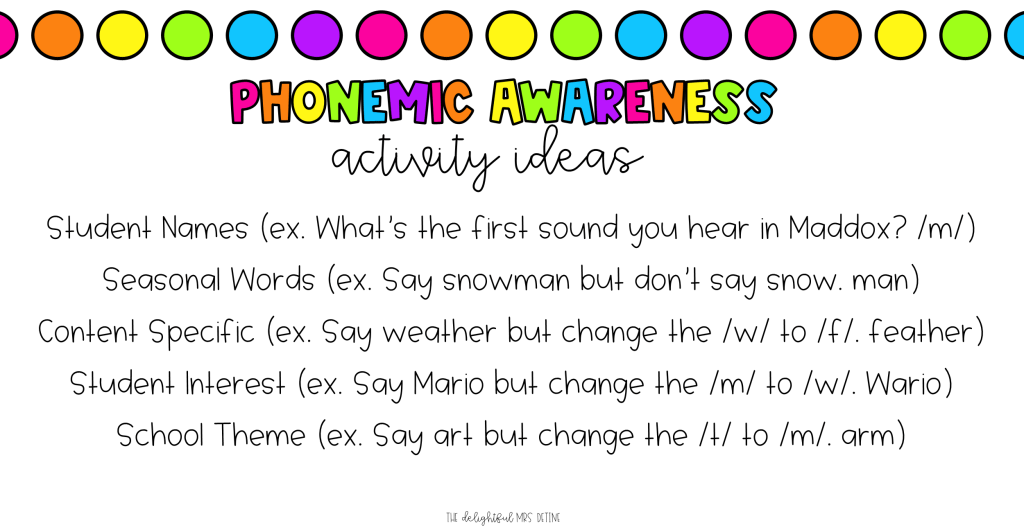
If you have a struggling reader in your classroom, I urge you to work on phonemic awareness with that student. Students can struggle with phonemic awareness regardless of age! I have kids in grades K-5 who are showing incredible growth and I credit phonemic awareness to that success. And the best part? The kids LOVE to do it! We think of it as a word game that warms up our brain for reading. They’re fun and are a powerful tool to help towards reading success!
Be sure to check out my Instagram and Facebook to see phonemic awareness practice in action. I post tips and tricks on there that I use in my groups. Let me know what phonemic awareness looks like in your classroom!
 thedelightfulmrsdetine.com